Posts

Showing posts with the label solar system

High Resolution Imaging Science Experiment (HiRise)

Image
High Resolution Imaging Science Experiment is a camera on board the Mars Reconnaissance Orbiter . The 65 kg (143 lb), $40 million USD instrument was built under the direction of the University of Arizona 's Lunar and Planetary Laboratory by Ball Aerospace & Technologies Corp. It consists of a 0.5 m (19.7 in) aperture reflecting telescope , the largest so far of any deep space mission, which allows it to take pictures of Mars with resolutions of 0.3 m/pixel (about 1 foot), resolving objects below a meter across. HiRISE has imaged Mars landers on the surface, including the ongoing Curiosity and Opportunity rover missions . [1] https://en.wikipedia.org/wiki/HiRISE   Portal   http://www.uahirise.org/  
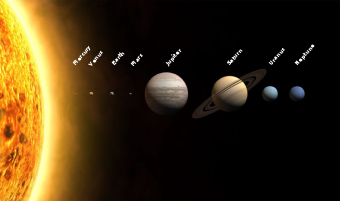
Solar System

Image
The Solar System [a] is the gravitationally bound system comprising the Sun and the objects that orbit it, either directly or indirectly. [b] Of those objects that orbit the Sun directly, the largest eight are the planets , [c] with the remainder being significantly smaller objects, such as dwarf planets and small Solar System bodies . Of the objects that orbit the Sun indirectly, the moons , two are larger than the smallest planet, Mercury . [d] The Solar System formed 4.6 billion years ago from the gravitational collapse of a giant interstellar molecular cloud . The vast majority of the system's mass is in the Sun, with most of the remaining mass contained in Jupiter . The four smaller inner planets, Mercury , Venus , Earth and Mars , are terrestrial planets , being primarily composed of rock and metal. The four outer planets are giant planets , being substantially more massive than the terrestrials. The two largest, Jupiter and Saturn , are gas giants , being compose...

Cassini Huygens mission

Image
Cassini–Huygens is an unmanned spacecraft sent to the planet Saturn . It is a Flagship -class NASA – ESA – ASI robotic spacecraft . [4] Cassini is the fourth space probe to visit Saturn and the first to enter orbit, and its mission is ongoing as of 2016. It has studied the planet and its many natural satellites since arriving there in 2004. [5] https://en.wikipedia.org/wiki/Cassini%E2%80%93Huygens   Destination Titan (Vid) Portal  

Solar Dynamics Observatory (SDO)

Image
The Solar Dynamics Observatory (SDO) is a NASA mission which has been observing the Sun since 2010. [4] Launched on February 11, 2010, the observatory is part of the Living With a Star (LWS) program. [5] The goal of the LWS program is to develop the scientific understanding necessary to effectively address those aspects of the connected Sun – Earth system directly affecting life and society. The goal of the SDO is to understand the influence of the Sun on the Earth and near-Earth space by studying the solar atmosphere on small scales of space and time and in many wavelengths simultaneously. SDO has been investigating how the Sun's magnetic field is generated and structured, how this stored magnetic energy is converted and released into the heliosphere and geospace in the form of solar wind , energetic particles, and variations in the solar irradiance . [6 https://en.wikipedia.org/wiki/Solar_Dynamics_Observatory   Portal  

Juno Mission

Image
Juno is a NASA space probe orbiting the planet Jupiter . It was built by Lockheed Martin and is operated by NASA 's Jet Propulsion Laboratory . The spacecraft was launched from Cape Canaveral Air Force Station on August 5, 2011 ( UTC ), as part of the New Frontiers program , [6] and entered a polar orbit of Jupiter on July 5, 2016 (UTC), [4] [7] to begin a 20-month scientific investigation of the planet. [8] After completing its mission, Juno will be intentionally deorbited into Jupiter's atmosphere. [8] Juno 's mission is to measure Jupiter's composition, gravity field , magnetic field , and polar magnetosphere . It will also search for clues about how the planet formed, including whether it has a rocky core, the amount of water present within the deep atmosphere, mass distribution , and its deep winds, which can reach speeds of 618 kilometers per hour (384 mph). [9]      https://en.wikipedia.org/wiki/Juno_(spacecraft)   http://spaceflight101....

Io

Image
Io ( pronunciation: / ˈ aɪ . oʊ / [7] ) is the innermost of the four Galilean moons of the planet Jupiter . It is the fourth-largest moon , has the highest density of all the moons, and has the least amount of relative water of any known object in the Solar System . It was discovered in 1610 and was named after the mythological character Io , a priestess of Hera who became one of Zeus 's lovers. With over 400 active volcanoes , Io is the most geologically active object in the Solar System. [8] [9] This extreme geologic activity is the result of tidal heating from friction generated within Io's interior as it is pulled between Jupiter and the other Galilean satellites— Europa , Ganymede and Callisto . Several volcanoes produce plumes of sulfur and sulfur dioxide that climb as high as 500 km (300 mi) above the surface. Io's surface is also dotted with more than 100 mountains that have been uplifted by extensive compression at the base of Io's silicate crust....

Elon Musk’s Mars colonization plan in 5 minutes

Image
Elon explains in this Vid

Voyager 1

Image
Voyager 1 is a space probe launched by NASA on September 5, 1977. Part of the Voyager program to study the outer Solar System , Voyager 1 launched 16 days after its twin, Voyager 2 . Having operated for 39 years, 1 month and 11 days, the spacecraft still communicates with the Deep Space Network to receive routine commands and return data. At a distance of 135 AU (2.02 × 10 10  km) from the Sun as of June 2016, [3] it is the farthest spacecraft from Earth . The probe's primary mission objectives included flybys of Jupiter , Saturn , and Saturn's large moon, Titan . While the spacecraft's course could have been altered to include a Pluto encounter by forgoing the Titan flyby, exploration of the moon, which was known to have a substantial atmosphere, took priority. [4] [5] [6] It studied the weather, magnetic fields, and rings of the two planets and was the first probe to provide detailed images of their moons . After completing its primary mission w...

Jupiter Portal

Image
Jupiter is the fifth planet from the Sun and the largest planet within the Solar System . It is a gas giant with a mass slightly less than one-thousandth of the Sun but is two and a half times the mass of all the other planets in our Solar System combined. Jupiter is classified as a gas giant along with Saturn , Uranus and Neptune . Together, these four planets are sometimes referred to as the Jovian or outer planets. The planet was known by astronomers of ancient times and was associated with the mythology and religious beliefs of many cultures. The Romans named the planet after the Roman god Jupiter . When viewed from Earth , Jupiter can reach an apparent magnitude of −2.94, making it on average the third-brightest object in the night sky after the Moon and Venus . ( Mars can briefly match Jupiter's brightness at certain points in its orbit.) https://en.wikipedia.org/wiki/Portal:Jupiter    

Triton

Image
Triton is the largest natural satellite of the planet Neptune . It was discovered on October 10, 1846, by English astronomer William Lassell . It is the only large moon in the Solar System with a retrograde orbit , an orbit in the opposite direction to its planet's rotation. [2] [11] At 2,700 kilometres (1,700 mi) in diameter, it is the seventh-largest moon in the Solar System. Because of its retrograde orbit and composition similar to Pluto 's, Triton is thought to have been a dwarf planet captured from the Kuiper belt . [12] Triton has a surface of mostly frozen nitrogen , a mostly water-ice crust, [13] an icy mantle and a substantial core of rock and metal. The core makes up two-thirds of its total mass. Triton has a mean density of 2.061 grams per cubic centimetre (0.0745 lb/cu in) [5] and is composed of approximately 15–35% water ice. [6] Triton is one of the few moons in the Solar System known to be geologically active . As a consequence, its surface is...