Posts

Parker Solar Probe

Image
Parker Solar Probe (previously NASA Solar Probe, Solar Probe Plus, or Solar Probe+) is a planned NASA robotic spacecraft to probe the outer corona of the Sun . It will approach to within 8.5 solar radii (5.9 million kilometers or 3.67 million miles) to the 'surface' ( photosphere ) of the Sun. [2] The project was announced as a new mission start in the fiscal 2009 budget year. On May 1, 2008 Johns Hopkins University Applied Physics Laboratory announced it will design and build the spacecraft, on a schedule to launch it in 2015. [3] The launch date has since been pushed back to 2018, [4] with the Delta IV Heavy as the launch vehicle. [1] On May 31st, 2017 the probe was renamed after solar astrophysicist Eugene Parker [5] . According to NASA, this was the first time in history a space vessel was named after a living person. [6] https://en.wikipedia.org/wiki/Parker_Solar_Probe   NASA PSP

Juno - A Whole New Jupiter

Image
https://www.nasa.gov/press-release/a-whole-new-jupiter-first-science-results-from-nasa-s-juno-mission Early science results from NASA’s Juno mission to Jupiter portray the largest planet in our solar system as a complex, gigantic, turbulent world, with Earth-sized polar cyclones, plunging storm systems that travel deep into the heart of the gas giant, and a mammoth, lumpy magnetic field that may indicate it was generated closer to the planet’s surface than previously thought. “We are excited to share these early discoveries, which help us better understand what makes Jupiter so fascinating,” said Diane Brown, Juno program executive at NASA Headquarters in Washington. "It was a long trip to get to Jupiter, but these first results already demonstrate it was well worth the journey.” https://www.youtube.com/watch?v=6o9FiTf1vZE

High Resolution Imaging Science Experiment (HiRise)

Image
High Resolution Imaging Science Experiment is a camera on board the Mars Reconnaissance Orbiter . The 65 kg (143 lb), $40 million USD instrument was built under the direction of the University of Arizona 's Lunar and Planetary Laboratory by Ball Aerospace & Technologies Corp. It consists of a 0.5 m (19.7 in) aperture reflecting telescope , the largest so far of any deep space mission, which allows it to take pictures of Mars with resolutions of 0.3 m/pixel (about 1 foot), resolving objects below a meter across. HiRISE has imaged Mars landers on the surface, including the ongoing Curiosity and Opportunity rover missions . [1] https://en.wikipedia.org/wiki/HiRISE   Portal   http://www.uahirise.org/  

Comparative Planetology

Comparative planetary science or comparative planetology is a branch of space science and planetary science in which different natural processes and systems are studied by their effects and phenomena on and between multiple bodies . The planetary processes in question include geology, hydrology, atmospheric physics, and interactions such as impact cratering, space weathering, and magnetospheric physics in the solar wind, and possibly biology, via astrobiology . Comparison of multiple bodies assists the researcher, if for no other reason than the Earth is far more accessible than any other body. Those distant bodies may then be evaluated in the context of processes already characterized on Earth. Conversely, other bodies (including extrasolar ones ) may provide additional examples, edge cases, and counterexamples to earthbound processes; without a greater context, studying these phenomena in relation to Earth alone may result in low sample sizes and observational biases. ...

Open Exoplanet Catalogue

Image
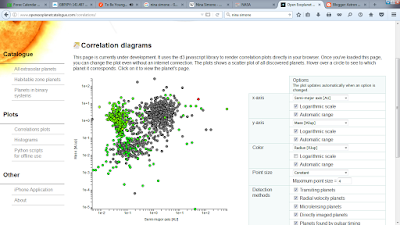
The Open Exoplanet Catalogue is a catalogue of all discovered extra-solar planets. It is a new kind of astronomical database. It is decentralized and completely open. We welcome contributions and corrections from both professional astronomers and the general public.  http://www.openexoplanetcatalogue.com/  

Trappist-1 (7 ExoPlanets)

Image
TRAPPIST-1, also known as 2MASS J23062928-0502285, [6] is an ultracool dwarf star [4] [7] located 39.13 light-years (12.0 pc) away in the constellation Aquarius . A team of astronomers headed by Michaël Gillon of the Institut d’Astrophysique et Géophysique at the University of Liège [8] in Belgium used the TRAPPIST (Transiting Planets and Planetesimals Small Telescope) telescope at the La Silla Observatory in the Atacama desert , Chile , [9] to observe TRAPPIST-1 and search for orbiting planets. By utilising transit photometry , they discovered seven Earth-sized planets orbiting the dwarf star; the innermost two are tidally locked to their host star while the outermost appears to lie either within the system's habitable zone or just outside of it. [7] [10] The team made their observations from September to December 2015 and published its findings in the May 2016 issue of the journal Nature . [9] [11] https://en.wikipedia.org/wiki/TRAPPIST-1   Portal  ...

Betelgeuse

Image
Betelgeuse, also designated Alpha Orionis (α Orionis, abbreviated Alpha Ori, α Ori), is the ninth-brightest star in the night sky and second-brightest in the constellation of Orion . Distinctly reddish, it is a semiregular variable star whose apparent magnitude varies between 0.0 and 1.3, the widest range of any first-magnitude star . Betelgeuse is one of three stars that make up the Winter Triangle asterism, and it marks the center of the Winter Hexagon . It would be the brightest star in the night sky if the human eye could view all wavelengths of radiation. https://en.wikipedia.org/wiki/Betelgeuse   Portal